

All over the U.S., community banks are growing, both in scale and profitability. This growth often means more branches and more territory – whether through an acquisition, or a building project. But here’s the dilemma: as community banks grow, they face a constant pull between corporate efficiency and the local, personal customer relationships on which they pride themselves.
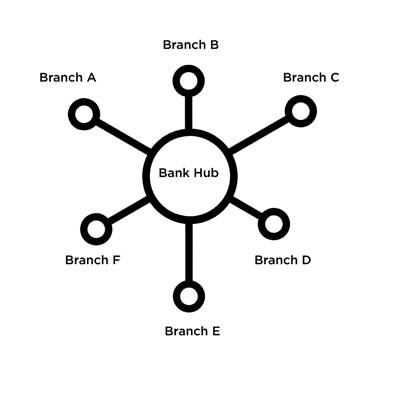
For executive leadership and marketing teams, this translates to a key question: should marketing strategy be built centrally at the bank level, or locally at the branch level? Each has pros and cons, but neither extreme works alone. The most effective marketing strategy uses a central “hub-and-spoke” model that combines central governance with local execution.
The Bank Level: Strategy, Governance, & Infrastructure
The hub-and-spoke model is neither top-down, nor bottom up; there is agency and decision-making power to be had at both the bank level and the branch level. The bank serves as the strategic marketing “hub,” providing operational scale and consistency. Key responsibilities include:
Brand Identity & Core Messaging: The brand standards should live at the bank level. Provide a unified value proposition, as well as guidelines for logo usage and tone of voice. This way, messaging and visual identity are consistent across communications and across branches.
Compliance & Legal Safeguards: Your bank’s compliance officer or legal team should review all content, providing language for FDIC disclosures, Fair Lending oversight, and other banking advertising regulations.
Technology & Data Infrastructure: The bank level provides the advantage of scale and purchasing power. For this reason, systems like a centralized CRM, website, email automation, and analytics should live there and be distributed outward to branches.
Broad Acquisition Campaigns: Regional digital ads, mass media, and footprint-wide product pushes are best served coming from the bank level. This provides branches with the opportunity to get more granular and hyper-local in their campaigns.
The Branch Level: Activation, Trust, & Relationships
If the bank is the centralized hub providing resources and stability, the branches are the execution “spokes,” driving local engagement and trust. Key responsibilities include:
Community Engagement: This is where community banks truly shine, setting themselves apart from megabank and large regional competitors. Community initiatives like Little League sponsorships, Chamber of Commerce participation, and charity drives are best driven by branch managers and staff.
Hyper-Local Storytelling: Every branch’s market looks different. That’s why they should each tell their own stories. Spotlighting local small business clients and branch staff is a great way to set your bank apart in each market.
Tailored Product Focus: Beyond broad campaigns at the bank-level, each branch has the opportunity to align their own marketing pushes with local economic needs. For example, a rural branch might see a higher demand for ag loans, while another in a more metropolitan area might need to push commercial real estate. Giving each branch the agency to run these campaigns ensures responsiveness to each market’s needs.
Direct Relationship Building: Relationships are the foundation of community banking, and branch staff need to be empowered to build them. When branches host local events and encourage staff to network, the bank builds local trust and its roots run deeper in the community.
The Solution: The “Hub-and-Spoke” Hybrid Model
Now to bring it all together with pre-approved toolkits, discretionary branch budgets, and a streamlined workflow. Here’s how it works:
Pre-Approved Toolkits serve as the hub from which all else flows. The central team provides compliant, editable templates, like flyers, social graphics, and direct mail, for local staff to customize.
Discretionary Branch Budgets serve as the spokes to execute marketing strategy at the branch level.Allocate dedicated local funding for branch managers to support local causes directly.
A Streamlined Workflow keeps the wheel rolling. Create simple submission processes for central marketing review and fast compliance clearance.
For growing community banks, marketing strategy can’t live only at the bank level, nor at the branch level. A hybrid strategy is the most effective: centralize strategy, brand standards, and the marketing tech stack; decentralize community relationships and local storytelling. Audit current branch marketing workflows to identify where local teams need more support or clearer compliance guardrails.